

An RTP percentage can look like the most useful number in a slot review, but only when its source and meaning are clear. This cc6 guide explains how to evaluate return claims, payout examples, and session results when researching Crazy FaFaFa.
The supplied review quotes 97.1%. Treat that figure as unverified unless it appears in the relevant game information. Repeating a percentage across several articles does not establish that it applies to the version you are viewing.

What RTP Can and Cannot Tell You
RTP describes a theoretical long-run return relative to total stakes under a game’s mathematical model. It does not describe the proportion of players who win, the chance that one spin pays, or the amount a particular player will recover.
A short session can finish far above or below a theoretical return. The percentage is not a refund promise, and a losing sequence does not create an obligation for the game to repay a particular player.
For readers using cc6 to research slot terms, the most useful habit is to distinguish a published mathematical measure from a prediction about personal results.
Compare the Numbers Correctly
| Measure | What it describes | Common misunderstanding |
|---|---|---|
| RTP | Theoretical return relative to stakes over extensive play | A guaranteed personal refund |
| Hit frequency | How often a paying result occurs | How often a player finishes ahead |
| Maximum win | A stated upper award under specific rules | A realistic target for every session |
| Total stakes | All amounts wagered, including reused winnings | Only the original deposit |
| Net result | Payouts minus stakes for the measured period | The size of the largest win animation |
A Simple Payout Example
Suppose a hypothetical session contains 20 paid spins at ₱5 each. Total stakes are ₱100. If the combined awards are ₱65, the net result is a ₱35 loss.
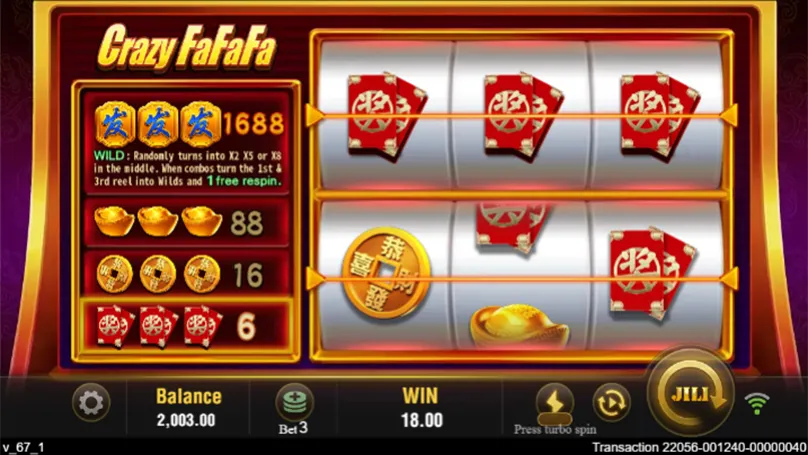
Those numbers illustrate accounting only. They are not Crazy FaFaFa’s minimum bet, expected result, or payout forecast. Even a visually impressive individual award does not by itself show whether the full session was profitable.
Why Total Stakes Matter
If winnings are used for more spins, total turnover can exceed the initial amount set aside. For example, placing ₱100 of bets, receiving ₱60, and wagering that ₱60 creates ₱160 of total stakes. It does not mean the player deposited ₱160.
Verify Before Repeating an RTP Claim
Open the help menu and look for the return information. Record the exact title and relevant version details if provided. If the percentage is absent, a responsible review should say that it is unavailable rather than borrow a number from a similarly named game.
This cc6 article intentionally avoids turning the supplied 97.1% statement into a confirmed specification. Readers should use the actual game disclosure when available.
Does a Higher RTP Guarantee a Better Session?
No. A theoretical percentage alone cannot tell you which game will produce the better result during a particular short session. It should be considered alongside clear rules and an amount you can afford to lose, rather than used as a reason to continue betting.
Conclusion
The clearest payout review separates confirmed information, hypothetical examples, and unknown details. Use this cc6 guide to interpret Crazy FaFaFa claims carefully and judge results by the full session balance rather than a single displayed win.