

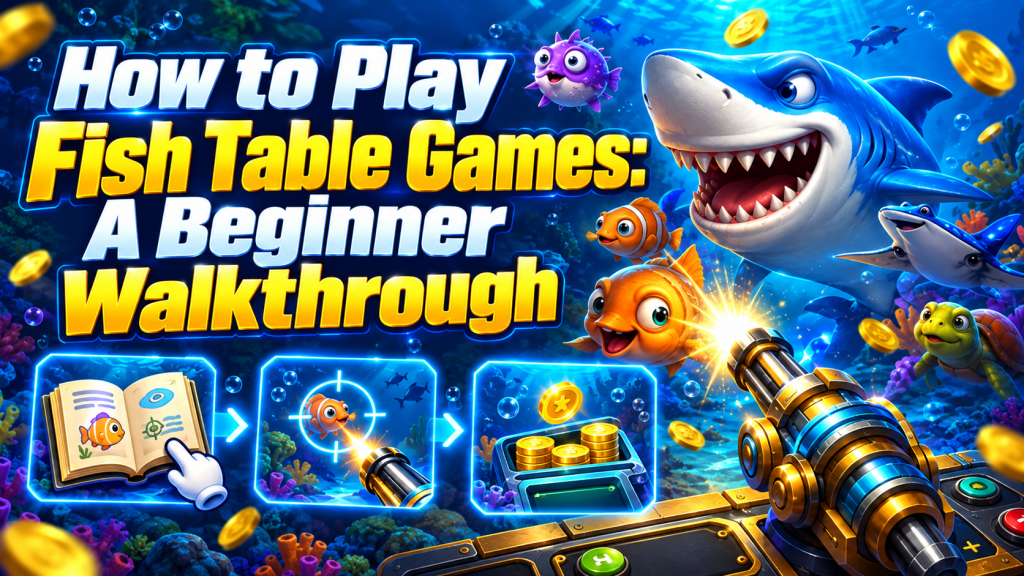
The easiest way to understand a fish table game is to learn one control at a time. Before looking at special targets, establish how the game charges for shots, how it records captures and where it displays the current balance.
If cc6 is part of your search for a beginner fishing game guide, use the steps below as a checklist for the exact title you are considering. They do not assume that every service carries the same games or supports the same features.
Step 1: Identify the Game and Open Its Help Menu
Read the provider name and game title. Open the instructions before starting a paid action. Look for the explanation of target values, available stake levels and any special round or weapon rules.
Do not copy a stake range or feature description from another game with similar artwork. Even closely related titles can use different interfaces and award structures.
Step 2: Locate the Essential Controls
| Control | First question to answer |
|---|---|
| Shot setting | What does one paid action cost? |
| Cannon direction | How do I select the intended target? |
| Fire control | Is this a single shot, sustained input or toggle? |
| Information button | Where are target values and feature rules explained? |
| Exit control | How do I stop firing and leave? |
Step 3: Try a Demo if One Is Offered
Practice aiming, changing the shot setting and stopping fire. The goal is to understand the interface, rather than treating trial awards as evidence of future profitability.
For cc6 readers, a useful demo exercise is to fire a small number of shots and compare the displayed balance before and afterward. Check whether a special action uses a separate charge or a different stake calculation.
Step 4: Read an Award Correctly
An amount added to the balance is an award, not necessarily a profit. If a sequence costs 6 credits and pays 4 credits, the net result is a loss of 2 credits. Clear accounting prevents a large animation from obscuring the overall result.
Check the Meaning of a Multiplier
A multiplier may refer to the current bullet stake or another defined amount. Use the game’s wording. Do not multiply by your entire balance or session spending unless the rules explicitly require that calculation.
Step 5: End the Session Deliberately
Stop firing, allow accepted actions to resolve and check the settled balance. Keep any available session identifier if an award or deduction needs clarification.
Someone researching cc6 should verify how the selected game records history before relying on it to resolve a question later. An exit button and a transaction record serve different purposes.
Beginner FAQ
Must I Start With a Large Cannon?
No. First understand what the setting changes and how much each action costs. A bigger visual weapon does not establish better value.
Is Every Fish Worth the Same Amount?
Target awards can differ. Check the title’s paytable rather than relying on color, size or animation.
Can a Tutorial Promise a Winning Session?
No. A tutorial can explain inputs and calculations; it cannot guarantee a favorable gambling result.
Begin With Understanding
The essential skills are reading the rules, recognizing a paid action and tracking the balance. Apply those checks to any title you investigate through cc6 before deciding whether its controls and costs are clear enough for you.